
Cooling and Humidification Systems in Greenhouses
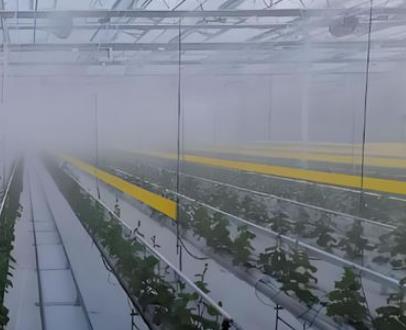
The Netherlands is currently the world’s most advanced country in the greenhouse industry and is known as the “Greenhouse Kingdom.” With its advanced smart greenhouse technology, extremely high production efficiency, and well-developed industrial chain, its global leadership is undisputed. Despite its small land area and limited arable land, the Netherlands has achieved highly efficient and intensive agricultural production through high-tech facility agriculture.
Its smart greenhouses commonly employ automated environmental control, hydroponics, precision irrigation, and LED supplemental lighting. Vegetable yields per unit area can reach nearly twice those of China, requiring only minimal manual labor. The country’s approximately 17,000 hectares of glass greenhouses account for one-quarter of the global total, primarily used for flower and vegetable production, which supports its status as the world’s second-largest agricultural exporter.
Furthermore, the Netherlands’ “Greenport” model highly integrates research, production, trade, and logistics. Centered around the city of Westland, it has formed a world-leading horticultural industry cluster that continuously drives technological innovation and the commercialization of research outcomes.
Dutch smart greenhouses primarily utilize high-pressure fogging systems and evaporative cooling systems as core methods for cooling and humidification, combined with automated controls to achieve precise environmental regulation.
1. High-Pressure fogging cooling and humidification system
This system uses a high-pressure pump to pressurize water to 70–120 kg/cm², which is then delivered to nozzles after micron-level filtration, forming fine mist particles with a diameter of 10–50 microns. These fine mist particles evaporate rapidly, absorbing heat from the air to achieve a cooling effect of 3–10°C while simultaneously increasing air humidity. The system is also versatile and can be used for foliar fertilization, pesticide application, and artificial landscaping. During periods of high summer temperatures, it often works in conjunction with natural or forced ventilation to enhance cooling uniformity.
2.Evaporative cooling pad-fan system
This system As outdoor air passes through a moist cooling pad, water evaporation absorbs heat, lowering the temperature of the air entering the greenhouse. This system is typically paired with negative-pressure fans to create “negative-pressure ventilation,” ensuring even distribution of cool air. When the outdoor temperature reaches 40°C, it can maintain the greenhouse temperature below 30°C, making it an essential configuration for greenhouses in hot regions.
Additionally, Dutch greenhouses are equipped with automated environmental control systems. Sensors monitor parameters such as temperature, humidity, light intensity, and CO₂ concentration in real time, while computers automatically activate or deactivate misting or ventilation equipment to achieve precise, round-the-clock regulation. This data-driven management model has completely transformed traditional cultivation methods that relied on experience.
Greenhouses typically use fog nozzles made of 316 stainless steel with ceramic orifices, which offer long service life and low maintenance costs. Furthermore, greenhouse misting systems impose strict requirements on piping, fittings, and nozzles. In larger greenhouses, where system operating pressures exceed 100 bar, 304 or 316 precision stainless steel tubing is commonly selected. Fog nozzles are also made of 304 or 316 materials; brass is not used because it lacks the pressure resistance of stainless steel and is prone to leaks.
RELAB offers a range of fog nozzles specifically designed for greenhouse cooling and humidification systems, backed by over a decade of application experience. Our fog nozzles feature a long service life and low maintenance costs, especially the FG fog nozzles have a service life of up to 6~8 years and can last even longer after replacing internal components.
FE Filterable Ceramic Mist Nozzle
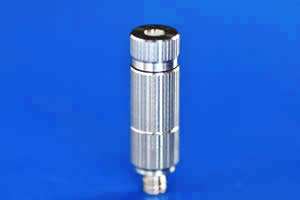
Model FE is a lengthened high pressure mist nozzle. Besides of the anti-drip valve, it still has a filter base. Its mini. orifice diameter is 0.1mm. The 316 stainless steel is available on request.
Read MoreFF Filterable Ceramic Mist Nozzle
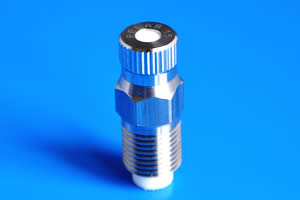
Model FF is made of 304 stainless steel, which consists of the body, cap, spray disc, anti-drip valve and filter plug. It has a hexagon body with 1/8" male taper pipe threads. All parts are removable, cleanable and replacement.
Read MoreFG 316SS Ceramic Fog Nozzle
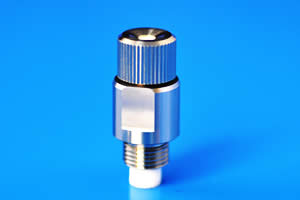
Compared to the FD, FE and FF series, the FG model has a larger ceramic spray disc and SS316 body. Ceramic material has a higher finish than stainless steel, and the liquid has a stronger pass rate at the same pressure.
Read MoreFI Ceramic Fine Mist Nozzle
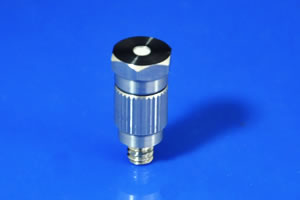
Model FI mist nozzle has the same structure as other FD Series, the difference is that the nozzle cap is a hexagon, and there is a longer taper at the bottom of the nozzle body to accommodate different environments for hanging.
Read More