
Coverage Area of a Hollow Cone Nozzle
The coverage area of a hollow cone nozzle (i.e., the diameter or area of the spray cone) is a critical parameter in spray system design and is commonly used in applications such as cooling, cleaning, humidification, combustion, and pesticide spraying. The theoretical coverage of a nozzle can be calculated by the spray angle and the distance from the nozzle to the target. The arrangement of nozzles must ensure uniform coverage through proper overlap to prevent “short-circuiting” of the spray.
Calculation of Hollow Cone Nozzle Coverage

| D: Spray coverage diameter at a vertical distance H from the nozzle outlet (unit: m or mm; must match H) H: Vertical distance from the nozzle outlet to the target surface (unit: m) θ: Nozzle spray cone angle (unit: degrees), provided by the manufacturer (common range: 30°–150°) |
Actual coverage is influenced by factors such as slurry viscosity, density, and pressure. When the liquid viscosity exceeds that of water, the spray angle decreases, and the coverage area shrinks; conversely, liquids with lower surface tension may widen the spray angle.
Arrangement of Hollow Cone Nozzles
To ensure uniform slurry distribution within the spray layer without dead zones, nozzles must be staggered and effectively overlapped. Matrix or concentric circle arrangements are commonly used, with nozzles in each layer staggered to improve coverage. The outermost layer of nozzles is maintained at a reasonable distance from the tower wall to prevent erosion or slurry leakage caused by impact.
The spray height of each layer should be greater than 1.2 times the nozzle coverage diameter, with a typical inter-layer spacing of 0.8 to 1.2 meters. Usually, 3 to 4 spray layers are installed to ensure a gas-liquid contact time of more than 2 seconds, thereby improving desulfurization efficiency.
Overlap Requirements for Hollow Cone Nozzles
The spray coverage areas of adjacent nozzles should overlap by 1/3 to 1/4 to ensure a slurry coverage rate of at least 170%–250% and prevent flue gas from escaping through gaps. For example, if a single nozzle has a coverage diameter of 1.2 meters at the spray layer height, the spacing between adjacent nozzles should be controlled at approximately 0.9~1.0 meters.
Flow Distribution Characteristics of Hollow Cone Nozzles
Hollow cone nozzles typically exhibit a concave flow distribution (lower flow in the center, higher flow at the edges). When arranging multiple nozzles, special attention must be paid to the overlap design to compensate for the lower spray intensity in the central area. If nozzles with uniform flow distribution are used, the overlap can be reduced to 10%, thereby improving energy efficiency.
A-W Hollow Cone Nozzle
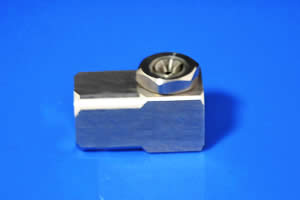
Model A-W is a tangential-flow hollow cone nozzle with a female thread body, which is a combination of two pieces. The range of flow rate is from 0.32LPM to 32LPM at 2 bar. It delivers a wide spray angles of 95°~144° at 2 bar.
Read More316SS Mixing Eductor Nozzle
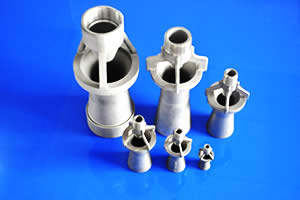
Mixing Eductor Nozzles can often replace motor-driven mechanical agitators and avoid the maintenance associated with mechanical devices.
Read More