
Spray Impact
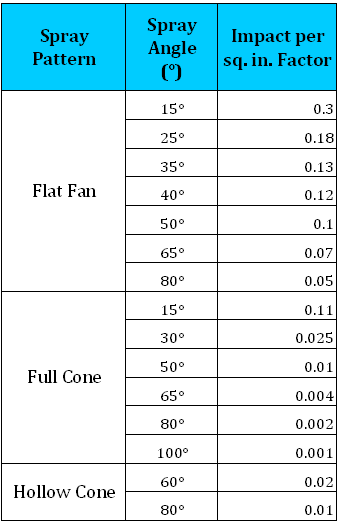
Impact is a measure of the force at which a spray liquid impinges on a surface. Its value depends on the six factors: liquid density, nozzle type, working pressure, flow rate, spray angle and installation distance. Impact per square inch (cm) [pounds (kg)-force per square inch (cm)] can be calculated.

| I = total theoretical spray impact K = constant Q = flow rate P = liquid pressure |
Total theoretical impact = constant (based on units) x flow (at pressure P) x square root of pressure (P)
| I | lbs.(f) | kg(f) | Newtons | Newtons |
|---|---|---|---|---|
| K | .0526 | .024 | .24 | .745 |
| Q | gpm | lpm | lpm | lpm |
| P | psi | kg/cm2 | bar | Mpa |
The constant (K) is a unit conversion based on the measurement system used. The conversions are listed in the chart above.
Increasing the fluid pressure increases the overall internal energy of the fluid. How much of this increase in energy is used to atomize the spray and how much is used to increase momentum and impact depends very much on the nozzle being used.
The solid stream nozzles provide more impact than the flat fan nozzle, because the solid stream is concentrating more flow per area than the flat fan nozzle. The flat fan nozzles have a wider spray angle and the spray will provide you with more coverage but will concentrate more flow over a larger concentrated area.
A Hollow Cone Nozzle
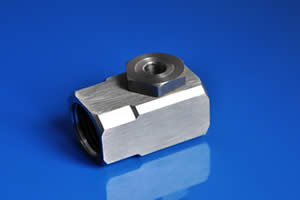
Model A is a tangential-flow hollow cone nozzle with a female thread body, which is a combination of two pieces. The range of flow rate is from 0.32LPM to 78LPM at 2 bar. It delivers a standard spray angles of 55°~90° at 2 bar.
BB Full Cone Nozzle
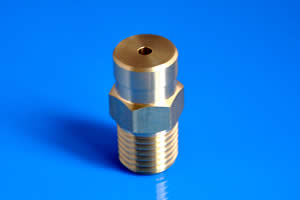
Model BB is the most commonly used full cone nozzle. It has a built-in X-style vane, which can better reduce clogging. If you want fast delivery, BB nozzle is the best choice.
CB Small-flow Flat Nozzle
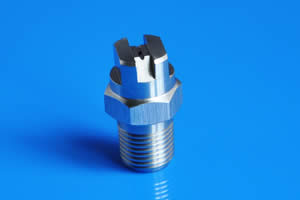
Model CB is a small flow flat fan nozzle with a T-shaped design to be more convenient and accurate arrangement and better spray effect. The coverage area overlaps by 30% to obtain complementary and more uniform distribution.
DA Standard Solid Stream Nozzle
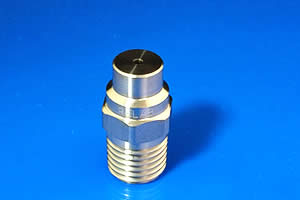
DA solid stream nozzle is complete brass or stainless nozzle without any inserts. The model produces a precise, concentrated and high-velocity stream which is longer distances than flat fan nozzles to handle tough cleaning applications.
General rules of thumb are that solid stream nozzles are the most efficient at transferring energy into momentum, followed by flat fan nozzles, then hollow cone nozzles, then full cone nozzles. It should be noted that often nozzles will be discussed as being very energy efficient. This often means they are very efficient at using internal fluid energy to atomize the fluid and so in this respect are very inefficient at energy transfer.
Nozzle Coverage Calculation
Droplet Size Basics
Main Factors Affecting Spray
The effective spray angle of a nozzle varies with spray distance, liquid viscosity, nozzle capacity and operating pressure. However, coverage is usually a theoretical calculation and should only be used as a reference. Also, keep in mind that spray angles listed in catalogs are based on spraying water. If spray coverage is critical in your application, contact us for additional data. If coverage isn't critical, use of an online calculator can provide the information you need.
A-W Hollow Cone Nozzle
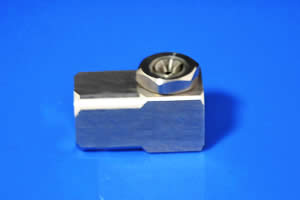
Model A-W is a tangential-flow hollow cone nozzle with a female thread body, which is a combination of two pieces. The range of flow rate is from 0.32LPM to 32LPM at 2 bar. It delivers a wide spray angles of 95°~144° at 2 bar.
Read More316SS Mixing Eductor Nozzle
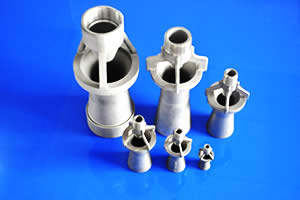
Mixing Eductor Nozzles can often replace motor-driven mechanical agitators and avoid the maintenance associated with mechanical devices.
Read More